
Remote Desktop Screenshot Shortcuts: A Complete Guide
Learning the remote desktop screenshot shortcut is essential for capturing errors. This article details the shortcut key for remote desktop and how to screenshot on remote desktop Windows 10 efficiently.

By Irene / Updated on February 9, 2026


🌟Quick Summary:
This article explains how Remote Desktop screenshot shortcuts work on both Windows and macOS and why taking screenshots in RDP sessions is often confusing. It clarifies which shortcuts capture the remote screen versus the local screen and where those screenshots are actually saved, a common source of mistakes for users.
The article also highlights key limitations of Remote Desktop, including black screens, low image quality, shortcut conflicts, and workflow issues caused by performance focused graphics handling and security restrictions. Because of these problems, relying on RDP for frequent or professional screen capturing can be inefficient.
To solve this, the article introduces AnyViewer as a more reliable alternative, offering high quality screenshots, simple capture steps, local saving, and secure remote access. Overall, it helps users understand RDP screenshot behavior and choose a smoother solution for clear and dependable remote screen captures.
What is Remote Desktop Screenshot Shortcuts on Mac and Windows?
Remote Desktop Protocol (RDP) allows you to access another computer remotely, but capturing what you see on that remote screen can sometimes be tricky due to different keyboard layouts. To help you navigate this, here are the default shortcuts used to trigger a screenshot command directly within the remote session.
| Operating System | Scenario | Shortcut / Method | What It Captures | Where the Screenshot Is Saved | Notes |
|---|---|---|---|---|---|
| Windows (Remote Desktop) | Switch display mode | Ctrl + Alt + Break | Not a screenshot | N/A | Toggles between full-screen and windowed mode, useful before capturing screenshots |
| Windows (Remote Desktop) | Full remote screen | Ctrl + Alt + Print Screen | Entire remote desktop | Remote Windows PC | Screenshot is saved on the remote machine, not the local computer |
| Windows (Remote Desktop) | Full remote display | Ctrl + Alt + + (numeric keypad) | Entire remote desktop | Remote Windows PC | The plus key must be from the numeric keypad |
| Windows (Remote Desktop) | Active window only | Ctrl + Alt + - (numeric keypad) | Active window in remote session | Remote Windows PC | The minus key must be from the numeric keypad |
| macOS (Remote Desktop to Windows) | Full local screen | Command + Shift + 3 | Entire local Mac screen | Local Mac | Captures the Mac screen, not the remote Windows desktop |
| macOS (Remote Desktop to Windows) | Selected area | Command + Shift + 4 | Selected area on local screen | Local Mac | Useful if the remote desktop is visible in a window |
| macOS (Remote Desktop to Windows) | Remote Windows screen | Use Windows shortcuts inside session (for example Ctrl + Alt + Print Screen) | Entire remote desktop | Remote Windows PC | Requires sending Windows key commands through the remote desktop app |
| macOS (Any remote desktop tool) | Full remote screen | Built-in screenshot feature of the remote tool | Entire remote desktop | Local Mac or remote computer | Many third-party tools allow direct capture to the local device |
While RDP can be useful for remote access, it is often unreliable for screen capturing. In real use, many users find the experience confusing and inefficient, especially when they need clear and usable screenshots. These limits come from how RDP handles graphics, input, and security, which can reduce both image quality and workflow efficiency.
-
Black screens and poor visuals: Screenshots may turn black when GPU rendering is enabled, display drivers are not set correctly, or the remote window is minimized. Sometimes, you may also encounter RDP full screen not working issue. It also focuses more on performance than image quality, so videos, animations, or fast-changing screens may look choppy or lose details.
-
Workflow and usability issues: It is easy to capture the screen but save the image on the remote computer instead of the local one because of clipboard confusion. Keyboard shortcuts can also conflict, especially for Mac users, making screen capture slower and less intuitive.
-
Security and software limits: Many organizations restrict clipboard access, file transfer, or recording tools for security reasons. In addition, some advanced screen capture or recording software does not work well inside RDP due to graphics acceleration limits, leading to low-quality results.
Because of these issues, relying on RDP for screen capturing can be frustrating. In sensitive or professional scenarios, extra permissions or alternative remote access tools are often needed to get reliable screenshots.
To bypass these technical inconsistencies and ensure you get crisp, easily accessible images every time, it is highly recommended to use a dedicated remote tool with built-in capture features. This leads us to The best software AnyViewer for Remote screenshot, which simplifies the process significantly.
🔥The best alternative to screenshot with Remote Desktop in Windows 10 and 11
If taking screenshots through Remote Desktop on Windows 10 or 11 often leads to black screens, delays, or usage limits, switching to a different remote access tool can make things much easier. A modern solution like AnyViewer is designed to avoid these common RDP problems and provide a smoother experience, especially when screen capturing is part of daily work.
- ★Powerful features of AnyViewer compared to Remote Desktop:
- Reliable screenshots without display issues: AnyViewer avoids common Remote Desktop problems like black screens and lag, delivering 4:4:4 True Color support with 4K high-quality picture for screenshot even on graphics-accelerated systems.
- Simple and efficient screenshot process : Users can capture the remote screen instantly, without shortcuts or complicated steps.
- Smooth workflow with local saving: Screenshots are saved directly to the local device, removing the need for clipboard syncing or manual file transfers and improving work efficiency.
- Secure and flexible remote access :AnyViewer supports cross-platform use and encrypted connections, making it suitable for both everyday tasks and environments that require data protection.
AnyViewer also works across different operating systems and uses encrypted connections to protect data during remote sessions. Overall, for users who want a simple, reliable way to take screenshots without RDP limitations, AnyViewer is a practical and dependable alternative.
Step 1. Install and launch AnyViewer on both computers. Go to Log in > Sign up to create an AnyViewer account. (If you already have signed up on its official website, you can log in directly.)
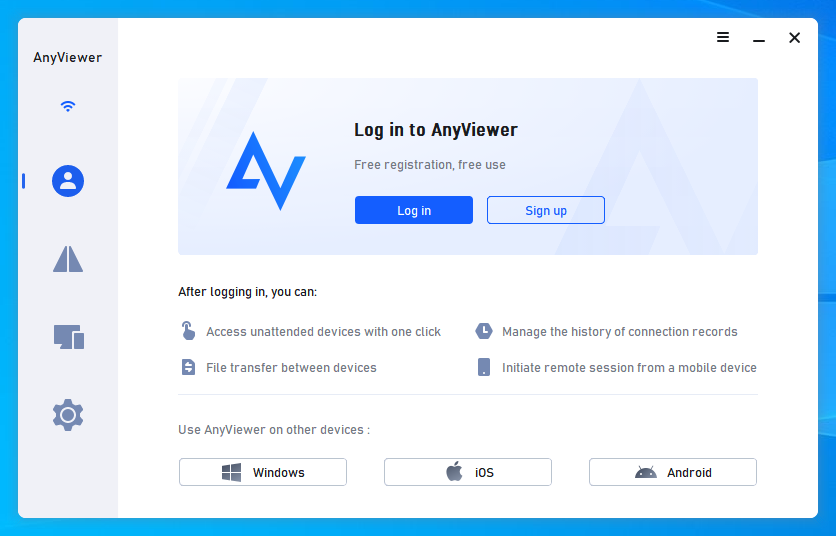
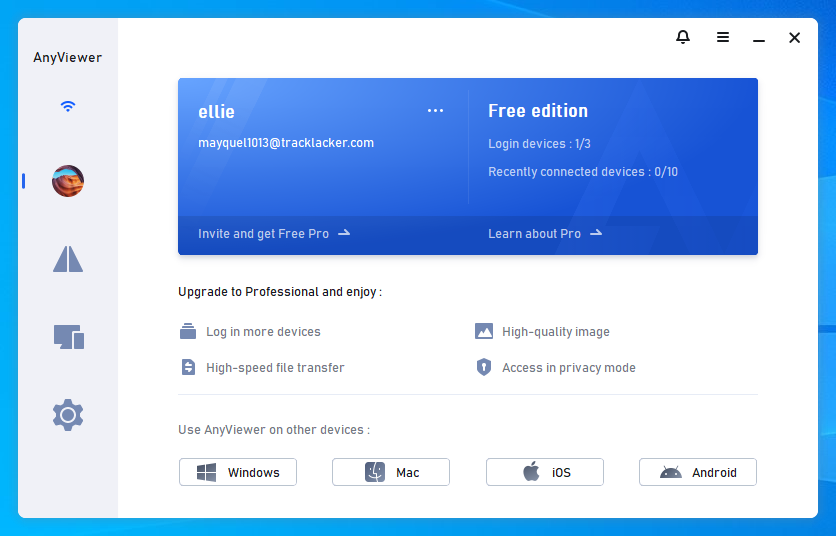
Step 2. Then you can see you successfully logged in to AnyViewer. Your device will automatically be assigned to the account you've logged in.
Step 3. Log in to the same AnyViewer account on the two devices; On your local device, go to Device, and then you can achieve a direct connection by clicking One-click control.
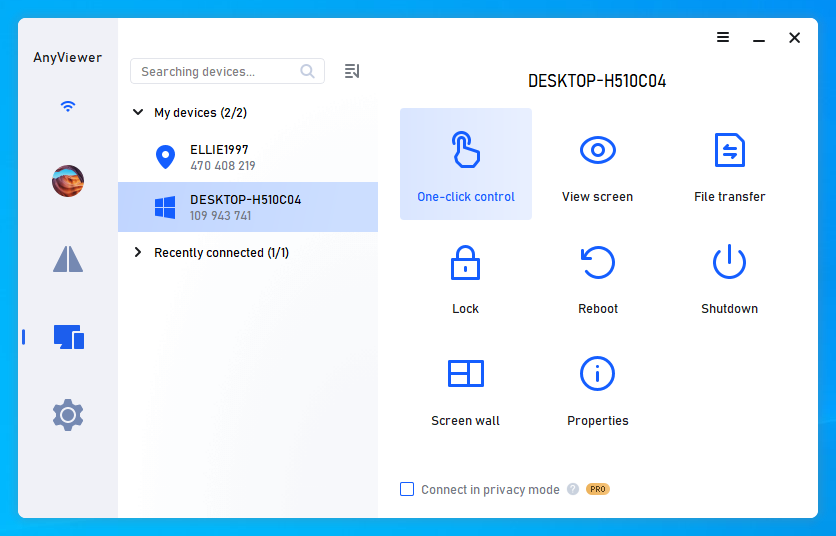
Then you can take screenshots on the remote computer just as if you were sitting in front of it.
- ★Tips
- AnyViewer also offers plans for teams and enterprises where you can:
- Assign more devices for one-click remote access.
- Enjoy high-quality image.
- Connect to a remote computer in privacy mode.
- Faster file transfer.
- ...
Conclusion
Using the right remote desktop screenshot shortcut makes it much easier to capture what you see during a remote session. Built-in Remote Desktop tools are convenient, but they also have clear limits. Users may face black screens, shortcut conflicts, or screenshots being saved on the wrong device. These problems can slow down work and create confusion, especially in professional or frequent use.
A dedicated remote access tool helps avoid these issues. With a solution like AnyViewer, you can take clear screenshots smoothly, save them directly to your local device, and work more efficiently, almost as if you were using the remote computer in person.
FAQs
🗨️ What does Ctrl + \ do?
Ctrl + \ is often used to interrupt or stop a running process in some command-line environments. Its exact function depends on the application you are using, and in many Windows programs it does nothing by default.
🗨️ What is the shortcut for full screen Remote Desktop?
Press Ctrl + Alt + Break to toggle Remote Desktop between windowed mode and full-screen mode.
🗨️ How to use Ctrl + Alt + Del while in RDP?
Press Ctrl + Alt + End. This sends the Ctrl + Alt + Del command to the remote computer instead of your local device.
🗨️ How do I know where my Remote Desktop screenshots are saved?
When you use screenshot shortcuts in a Remote Desktop session, the image is saved on the remote computer, not your local one. Check the remote desktop’s Pictures or Desktop folder.
🗨️ Why do Remote Desktop screenshots turn black or low quality?
This can happen because of GPU acceleration, display driver issues, or when the remote window is minimized. Remote Desktop focuses on performance, which can reduce screenshot quality or cause black screens.



 as a preferred
source on Google
as a preferred
source on Google