
How to Connect to Remote Computer via PowerShell (2026 Guide)
Enable PowerShell Remoting, and then you can connect to computer using PowerShell and manage the computer.

By Ellie / Updated on January 28, 2026


Can I connect to a remote computer using PowerShell?
Hi, everyone! Is it possible to use connect to a remote computer PowerShell and manage it with my local device? Can you tell me the detailed process? Please accept my heartfelt gratitude in advance!
- Question from Tina
PowerShell Remoting is a powerful feature that allows administrators to manage Windows machines remotely. By enabling it, you can execute commands, manage services, and troubleshoot systems without physically being at the device.
In this guide, we will walk you through how to enable PowerShell Remoting and establish a connection using different methods.
Prerequisites for PowerShell Remoting
Before you start to connect to remote computer via PowerShell, ensure the following conditions are met:
- Administrator Rights: Both local and remote computers must run PowerShell as Administrator.
- Same Network: By default, PowerShell remoting works best on the same LAN or Domain.
- WinRM Service: The Windows Remote Management (WinRM) service must be running.
Phase 1: Enable PowerShell Remoting on the target PC
It's well-known that Windows Remote Desktop allows a computer to be accessed by Remote Desktop Connection (MSTSC). Actually, you can also use PowerShell Remoting to connect to a remote computer and manage it. Before that, you should enable PowerShell Remoting on the computer to which you want to connect by following the steps below:
Step 1. On Windows 11/10, press Windows + X, and choose PowerShell (Admin) from the menu.

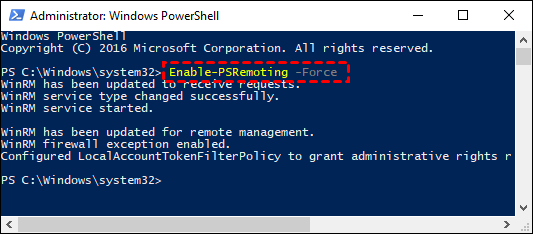
Step 2. In the PowerShell window, input the following command and hit Enter:
Enable-PSRemoting -Force
Phase 2: How to connect to a remote computer via PowerShell
Once enabled, you can connect from your local device using several methods depending on your needs. Here are detailed steps on how to connect to a remote computer using PowerShell.
Method 1: Start an interactive session (Enter-PSSession)
Use this if you want to stay connected and run multiple commands as if you were sitting at the remote PC.
Step 1. On the local computer, run PowerShell as administrator.
Step 2. Enter the following command and hit Enter:
Enter-PSSession -ComputerName COMPUTER -Credential USER
-
COMPUTER refers to the computer name or the IP address of the remote computer that you want to access; USER refers to the username of an account on the remote computer.
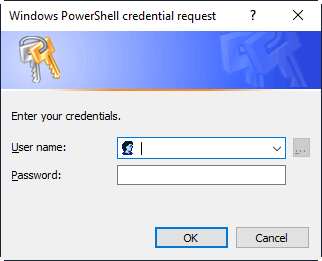
Step 3. In the pop-up window, input the password of the account and click OK.
Method 2: Execute a single command (Invoke-Command)
Use this for a "quick hit" without entering a full session.
Step 1. Run PowerShell as administrator.
Step 2. Run the command below and hit Enter:
Invoke-Command -ComputerName COMPUTER -ScriptBlock { COMMAND } -credential USERNAME
-
COMPUTER is the remote PC’s IP address or computer name; COMMAND refers to the command that you want to run on the remote computer; USERNAME refers to the username of anaccount on theremote computer.
Step 3. In the pop-up window, input the password of the account and click OK.
Phase 3: Launching Remote Desktop (RDP) from PowerShell
If you prefer a GUI (Graphical User Interface), you can trigger a Remote Desktop Connection directly from the PowerShell console. What you need to pay attention to is that this requires you to enable Remote Desktop on the remote computer in advance.
Step 1. Run PowerShell as Administrator.
Step 2. Run either one of the following two commands:
- mstsc /v:[IP address of the remote PC]:3389
- Start-Process "$env:windir\system32\mstsc.exe" -ArgumentList "/v:$[the computer name of the remote computer]"
Step 3. Now, input the username & password of the account that you want to log in to on the remote computer. After a while, you can see the desktop of the remote PC and use it.
Better alternative: Access remote PC across different networks
While PowerShell is robust, it has significant limitations:
- Network Barriers: It is difficult to set up over the Internet (requires VPN or complex Port Forwarding).
- Security Risks: Opening WinRM ports on public networks can be risky.
- Technical Steepness: Beginners often struggle with "Access Denied" or "WinRM TrustHost" errors.
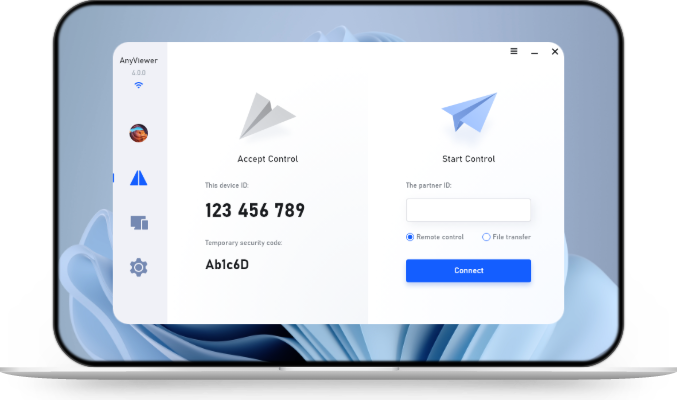
AnyViewer solves these problems. It is an all-in-one remote desktop solution that works across different networks (LAN, WAN, or 5G) without complex configurations.
Why choose AnyViewer?
- No Port Forwarding: Connect through firewalls and NAT effortlessly.
- One-Click Control: Access unattended remote computers with one click.
- Mobile Support: Control your Windows PC or MacBook from an iPhone or Android device.
- Built-in Tools: Integrated File Transfer, Chat, and Task Manager.
How to use it:
Step 1. Get AnyViewer on both your local and remote PCs.
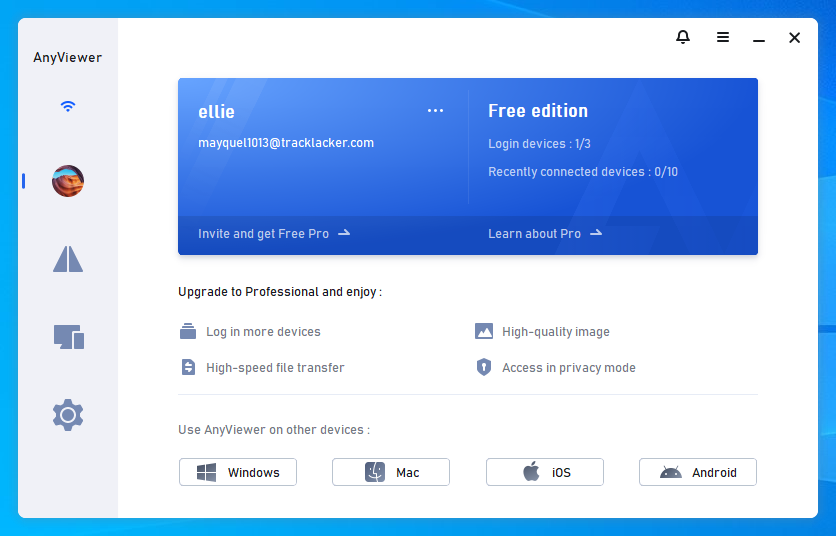
Step 2. Create a free account and log in on both devices.
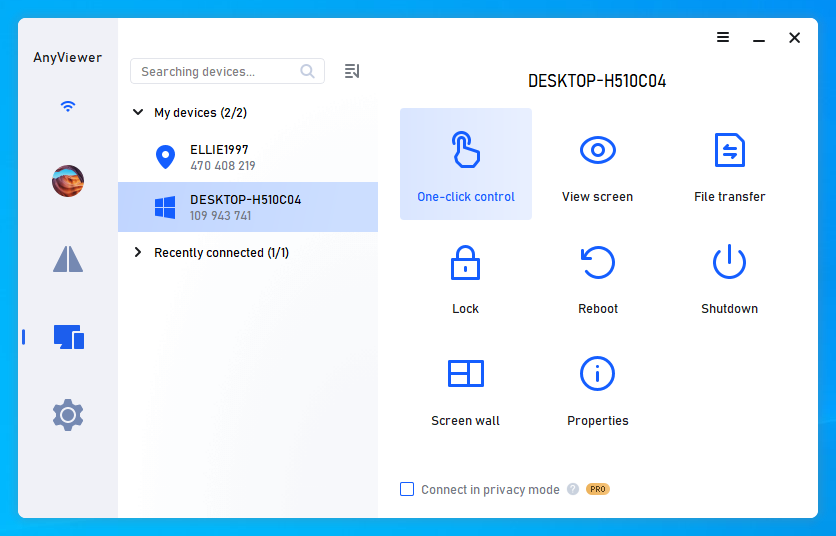
Step 3. Go to Devices, select your remote PC, and click One-click control.
🚀 Level Up Your Remote Experience:
If you need to manage a larger fleet of computers or require enterprise-grade security features, you can unlock advanced capabilities here. By opting for a higher-tier plan, you can enjoy:
- Massive Device Management: Assign up to 100 devices for one-click unattended access.
- Privacy Mode: Black out the remote screen and disable the keyboard/mouse to protect sensitive data while you work.
- High-Speed File Transfer: Transfer large logs or software installers at speeds up to 10MB/s with multi-channel support.
- More Simultaneous Sessions: Control multiple remote computers at the same time from one local console.
Conclusion
Connecting o remote computer using PowerShell is an efficient way to handle remote tasks via command lines. However, for a more stable, visual, and user-friendly experience, especially across different networks, AnyViewer is highly recommended as a comprehensive remote desktop solution.



 as a preferred
source on Google
as a preferred
source on Google